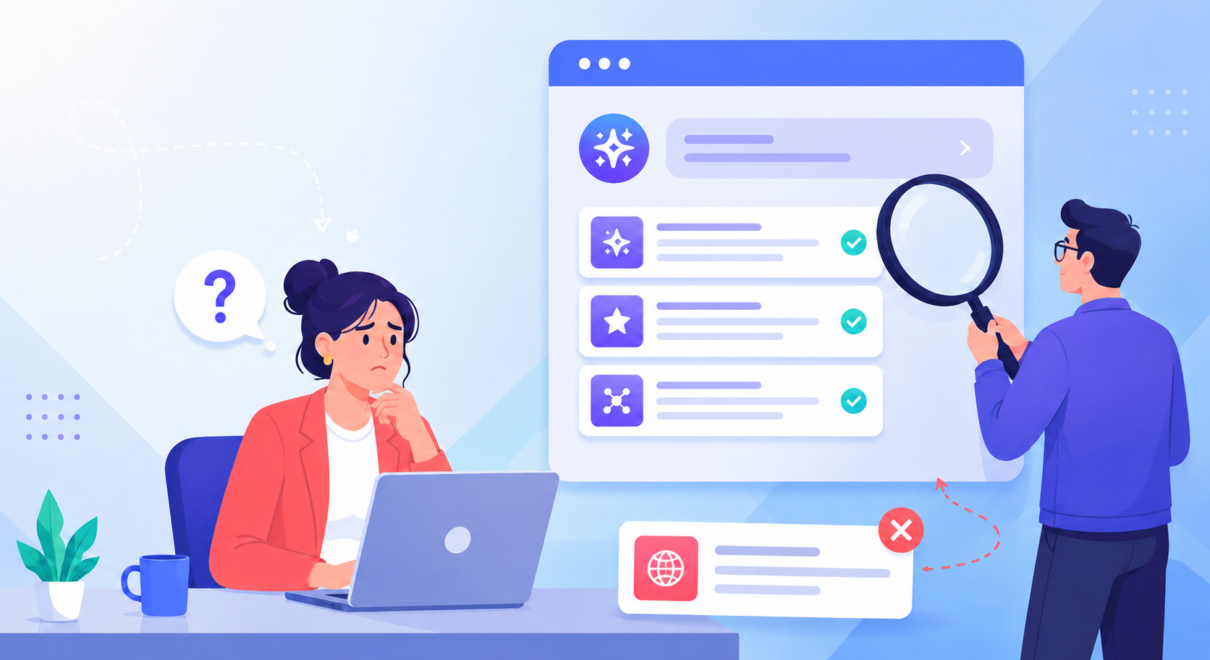
Why Your Website Is Not Appearing in AI Search Results
People are no longer using search engines only by entering short keywords. They are asking complete questions, requesting comparisons and using conversational search tools to make decisions. Google AI Overviews, Google AI Mode, ChatGPT Search and Microsoft Copilot can provide direct answers supported by information retrieved from websites. This creates a new visibility opportunity for businesses, but it also introduces a new question:
Why is your website not appearing in AI search results?
The short answer is that AI search visibility depends on more than adding keywords to a page. Your website must be accessible to search systems, technically indexable, clearly structured, relevant to the question and supported by reliable information.
Strong AI search optimisation begins with strong search engine optimisation. There is no guaranteed shortcut, special keyword formula or single piece of code that will make an AI platform cite your website.
What Are AI Search Results?
AI search results are generated responses that combine information from one or more sources to answer a user’s question. Instead of displaying only a list of links, an AI-powered search experience may:
- Provide a direct summary
- Compare several options
- Explain a process
- Recommend further areas to explore
- Display supporting links
- Cite websites used in the response
- Answer follow-up questions conversationally
OpenAI’s official documentation confirms that its web search technology can retrieve information from internet sources for use in generated responses. Google and Microsoft also use web content within their respective AI-powered search experiences. However, being available on the internet does not automatically mean that a page will be selected as a supporting source.
Why AI Search Visibility Matters for Businesses
A potential customer may ask:
- Which company provides website maintenance for small businesses?
- What should a monthly website maintenance plan include?
- How can I fix a slow WordPress website?
- Which web development company supports international clients?
- How much does a business website cost?
- What is the difference between website hosting and maintenance?
- Who can troubleshoot a website, server or DNS issue?
If your website contains relevant and reliable answers, it may become a candidate source for these searches. If the website is technically inaccessible, unclear or too generic, AI systems may select a competitor, directory, publication or another better-structured source instead. AI search visibility can therefore influence brand discovery, website traffic, business credibility and lead generation.
Is AI Optimisation Different from SEO?
AI optimisation, sometimes called AIO or answer engine optimisation, focuses on making website information easier for AI-powered systems to find, understand and use when generating answers. However, it should not be treated as a replacement for SEO. Google states that the same foundational SEO practices remain relevant for AI Overviews and AI Mode. It does not require a special AI file, unique AI markup or a separate technical optimisation method. To be eligible as a supporting link, a page must be indexed and eligible to appear in Google Search with a snippet. Read Google’s official guidance on AI features.
A practical AIO strategy therefore combines:
- Technical SEO
- Helpful content
- Clear website structure
- Business entity information
- Demonstrated experience
- Accurate structured data
- Strong internal linking
- Regular content maintenance
1. Your Website Is Not Properly Indexed
The first possible reason is technical. AI-powered search tools cannot effectively use a page if the systems supporting them cannot discover or access it. Common indexing problems include:
- The website blocks search crawlers
- Important pages contain a
noindexinstruction - The server returns an error instead of a successful page
- Pages are available only after logging in
- The XML sitemap is missing or outdated
- Incorrect canonical tags identify another URL as the main version
- Important pages have no internal links
- A firewall or content delivery network blocks crawler access
- Redirect loops prevent access
- JavaScript fails to display important content
Google’s minimum technical requirements state that Googlebot must not be blocked, the page should return an HTTP 200 success response and the page must contain indexable content. Meeting these conditions makes a page eligible for indexing, but indexing is still not guaranteed. Review Google Search technical requirements.
A technical SEO audit should therefore be the first step when a website is not appearing in either traditional or AI-powered search.
2. Your Content Does Not Answer Real Customer Questions
Many business websites focus almost entirely on promotional statements. Phrases such as “we provide innovative solutions” or “we are committed to excellence” may sound professional, but they do not explain what the business actually does, who it helps or how its service works. AI search queries are often specific and conversational.
A customer may want to know:
- What is included in the service?
- Who is the service suitable for?
- How does the process work?
- What problems can the company solve?
- Which technologies does the company support?
- What factors affect the price?
- Does the company support my country or industry?
- What happens after the project is completed?
Your service pages and blog articles should answer these questions clearly. Each important page should have one defined purpose rather than trying to cover every service, audience and location at once.
3. The Main Answer Is Difficult to Find
A page can contain useful information but still make the answer difficult to identify. This often happens when:
- The introduction is unnecessarily long
- Headings are vague
- Important information appears only near the bottom
- Several topics are mixed together
- Paragraphs are too dense
- The page repeats keywords without providing an answer
- The content uses complicated language unnecessarily
An AIO-friendly page should provide a concise answer shortly after introducing the question.
For example:
What is professional website maintenance?
Professional website maintenance is the ongoing process of updating, monitoring, protecting and improving a website after launch. It may include software updates, backups, security checks, performance optimisation and technical support. The page can then provide more detailed explanations below the direct answer. This answer-first structure helps visitors understand the content quickly and gives search systems clearer information to interpret.
4. Your Website Does Not Clearly Explain Who You Are
Search systems need to understand the organisation behind the content. A business website should provide consistent information about:
- The official business name
- Main services
- Industries served
- Countries or locations supported
- Business history
- Team experience
- Contact details
- Physical location, where applicable
- Social media profiles
- Company registrations or professional credentials, where relevant
- Authors or reviewers responsible for specialist content
This information should be consistent across the home page, About Us page, contact page, social profiles, business listings and structured data. If several business names, phone numbers or addresses appear across different platforms, search systems may have difficulty connecting those references to one organisation.
5. Your Content Is Too Generic
AI search systems have access to large amounts of general information. Rewriting information that already appears on hundreds of other websites gives them little reason to select your page. A stronger page provides something more useful, such as:
- First-hand experience
- A clearly explained process
- Original examples
- Practical checklists
- Professional observations
- Real project lessons
- Verified case studies
- Local market knowledge
- Industry-specific guidance
- Relevant comparisons
- Accurate and transparent limitations
For example, an article explaining website maintenance becomes more valuable when it discusses real operational issues such as failed contact forms, DNS problems, expired SSL certificates, incompatible plugins and unverified backups. Originality does not mean inventing new facts. It means adding genuine experience, context and practical value.
6. Your Website Lacks Trust and Authority Signals
AI-generated answers need sources that appear dependable. Trust may be supported by:
- Clear authorship
- Accurate business details
- Professional service descriptions
- Relevant qualifications or experience
- Genuine customer testimonials
- Approved case studies
- Transparent policies
- Working contact information
- References to reliable sources
- Regularly reviewed content
- Secure HTTPS connections
- A consistent online presence
Avoid unsupported claims such as “the best company”, “guaranteed results” or “100% secure”. These statements are difficult to verify and can reduce credibility. Explain what you do, how you work and what the customer can reasonably expect.
7. Important Information Is Available Only in Images
Search and AI systems understand text more reliably when important information is available in readable HTML. A website should not place essential service descriptions, prices, contact details or business explanations only inside:
- Posters
- Banners
- Infographics
- Scanned documents
- Videos
- Image-based sliders
- Downloadable brochures
Visual content can support a page, but the main information should also be explained in text. Images should have descriptive alternative text and videos should include useful summaries or transcripts where appropriate. Google specifically recommends making important content available in textual form when optimising websites for its AI search features.
8. Your Website Structure Is Unclear
Website structure helps visitors and search systems understand how different topics are connected. For example, a website development company might organise its content under:
- Website Development
- Website Maintenance
- WordPress Support
- Website Redesign
- Technical Troubleshooting
- Hosting and Server Support
- DNS and SSL Support
- White-Label Agency Support
Each main service can have a dedicated page supported by related articles, FAQs, case studies and internal links. If every service appears only in one long page, search systems may struggle to identify which section best answers a particular question. A clear structure also prevents several pages from competing for the same search intent.
Bing’s official webmaster guidance explains that duplicate or near-duplicate pages can blur intent signals and make it harder for search and AI systems to select the correct version. Read Bing’s duplicate content guidance.
9. Your Structured Data Is Missing or Incorrect
Structured data gives search engines explicit information about a page and the entity it represents. Depending on the website, relevant structured data may include:
- Organization
- LocalBusiness
- WebSite
- WebPage
- Article
- BreadcrumbList
- Service
- Product
- Event
- Person
Structured data should accurately represent information that visitors can also see on the page. Google explains that structured data can help it understand and classify website content. However, adding structured data does not guarantee a rich result, higher ranking or inclusion in an AI-generated answer. Learn how structured data works.
Incorrect, incomplete or misleading structured data can create more confusion than clarity.
10. Your Content Is Outdated
AI-powered search results may favour information that appears accurate and current, especially when the question relates to prices, services, regulations, technology or availability. Outdated content may include:
- Services the business no longer provides
- Incorrect contact information
- Old pricing
- Expired certifications
- Unsupported software versions
- Former staff members
- Broken external references
- Old screenshots
- Incorrect business hours
- Unavailable products
- Articles with no reviewed or updated date
Content should be reviewed on a planned schedule. Updating a page should involve more than changing the date. The facts, links, examples, metadata and recommendations should genuinely be checked.
11. Your Regional Relevance Is Not Clear
A business may serve customers in several countries, but its website may not explain this clearly. A Sri Lankan company serving international clients should provide accurate information about:
- Countries or regions supported
- Remote delivery capabilities
- Communication methods
- Relevant technologies
- Support arrangements
- Engagement models
- International project experience
- Payment and contractual processes, where appropriate
Avoid creating several nearly identical country pages that simply replace one location name with another. Each regional page should provide genuine market-specific value. Local businesses should also keep their Google Business Profile, location information, contact details and local service descriptions accurate.
12. You Are Focusing on AI Tricks Instead of Website Quality
Some businesses search for a special AI optimisation plugin, secret prompt, keyword formula or new file that will guarantee visibility. That approach can distract from the work that matters. Google confirms that websites do not need special AI text files or unique schema markup to appear in AI Overviews or AI Mode. Existing SEO foundations still apply. The strongest long-term approach is to publish information that is:
- Accessible
- Accurate
- Well structured
- Relevant
- Original
- Supported by experience
- Easy to verify
- Helpful to real users
AI search optimisation should improve the usefulness of a website rather than make the content feel artificially written for machines.
How to Improve Your Website’s AI Search Visibility
Step 1: Complete a Technical Visibility Audit
Check whether search crawlers can properly access and understand the website. The audit should review:
- Robots.txt rules
- Meta robots instructions
- HTTP status codes
- XML sitemap coverage
- Canonical tags
- Redirects
- Internal links
- Mobile compatibility
- Page loading performance
- HTTPS configuration
- JavaScript rendering
- Server and firewall restrictions
- Duplicate URLs
- Structured data errors
Use Google Search Console and Bing Webmaster Tools to inspect important URLs and indexing reports.
Step 2: Identify the Questions Customers Ask
Build content around real customer questions rather than isolated keywords. Sources may include:
- Sales inquiries
- Support requests
- Contact form submissions
- Customer meetings
- Search Console queries
- Website search data
- Industry forums
- Frequently asked questions
- Competitor content gaps
Group related questions under one clear topic instead of publishing many short pages with overlapping information.
Step 3: Create Answer-First Content
Each important page should include:
- A clear title
- A short direct answer
- A detailed explanation
- Practical examples
- Limitations or important conditions
- Relevant internal links
- A logical next action
Headings should describe the question or subject clearly. Avoid headings such as “Our Excellence” or “Powerful Solutions” when a more descriptive heading such as “What Our Website Maintenance Plan Includes” would be clearer.
Step 4: Strengthen Your Business Entity
Review whether your business identity is consistent throughout the website and other online platforms. Your organisation name, services, contact details, website address and social profiles should match. Create a complete About Us page and include genuine information about your history, experience, delivery process and areas of expertise.
Step 5: Demonstrate Real Experience
Publish content that shows how your business solves problems. This may include:
- Project summaries
- Before-and-after explanations
- Technical troubleshooting stories
- Maintenance activities
- Process documentation
- Approved customer feedback
- Lessons from completed work
- Practical checklists
Use client names, screenshots, testimonials and results only when publication approval has been obtained. Never invent performance improvements or customer outcomes.
Step 6: Add Accurate Structured Data
Use suitable structured data to clarify the organisation, article, service and website hierarchy. Validate the implementation using Google’s Rich Results Test and a schema validation tool. Structured data must match the visible page content and should be updated when business information changes.
Step 7: Improve Internal Linking
Connect related content naturally. For example, an article about AI search visibility might link to:
- Search engine optimisation services
- Website development
- Website maintenance
- Website redesign
- Technical support
- Related case studies
- Contact page
Internal links help visitors explore the topic and help search systems understand how pages relate to each other.
Step 8: Maintain and Review the Content
AI visibility is not a one-time project. Review important pages periodically to confirm that:
- Information remains correct
- Links still work
- Examples remain relevant
- Services are still available
- Structured data is valid
- Search crawlers can access the page
- New customer questions are addressed
- Content has not become duplicated
AI Search Visibility Checklist
Before expecting a page to appear in AI search results, confirm the following:
- The page is publicly accessible
- The page returns a successful HTTP response
- Search crawlers are not blocked
- The page is eligible for indexing
- The canonical URL is correct
- The page has a descriptive title
- The main question is answered clearly
- Important information is available as text
- The content provides original value
- Business information is consistent
- Claims can be verified
- The page includes relevant internal links
- Structured data matches the visible content
- The page works properly on mobile devices
- The content has been reviewed recently
- Search performance is being monitored
How Can You Measure AI Search Visibility?
AI search measurement is still developing and no single report covers every platform. Businesses can monitor:
- Google Search Console impressions and clicks
- Google Analytics referral traffic
- Bing Webmaster Tools
- Website server logs
- Branded search activity
- Visits from AI referral sources
- Leads mentioning AI-powered search
- Pages receiving new discovery traffic
Google introduced dedicated generative AI performance reporting in Search Console during 2026, initially rolling it out to selected websites. The reports provide information about visibility within features such as AI Overviews and AI Mode. Read Google’s announcement.
Bing has also introduced an AI Performance report in Bing Webmaster Tools to show when publisher content is referenced across Microsoft Copilot, Bing AI summaries and selected partner experiences. Read Bing’s AI Performance announcement.
These reports can help businesses identify which pages are being selected and where further improvements may be needed.
Frequently Asked Questions
Can anyone guarantee that my website will appear in AI search results?
No. Search engines and AI platforms decide which sources to display based on the query, available information and their own systems. A provider can improve technical accessibility, content quality and relevance, but cannot guarantee selection or citation.
How long does it take to improve AI search visibility?
There is no fixed timeline. Search systems must discover, crawl, process and evaluate updated content. Improvements may take several weeks or longer depending on the website, topic, competition and crawling frequency.
Do I need a special AI website file?
Google does not require a special AI text file, new machine-readable file or special schema markup for AI Overviews or AI Mode. Other platforms may have their own crawler controls and policies, so these should be reviewed separately.
Does structured data guarantee inclusion in AI answers?
No. Structured data can help search systems understand a page, but it does not guarantee ranking, citation or inclusion in AI-generated answers.
Is traditional SEO still important?
Yes. Technical SEO, indexing, content quality, internal linking, page experience and authority remain important foundations for both traditional and AI-powered search.
Can a Sri Lankan business appear in international AI search results?
Yes. A business website can be discovered internationally when its content is publicly accessible, relevant to the query and supported by clear service, market and authority information. The website should accurately explain the countries it supports and its ability to deliver services remotely.
Should every page be rewritten for AI search?
No. Begin with the pages that are most important to customers and revenue. Improve the home page, service pages, About Us page, case studies and high-value articles before expanding to less important content.
Prepare Your Website for AI-Powered Search
AI-powered search is changing how customers discover businesses, compare services and evaluate potential providers. However, the fundamentals remain familiar. Your website must be technically accessible, clearly organised, genuinely useful and supported by reliable business information. AI optimisation works best when it improves the experience for real people as well as search systems.
Established in 2013, Extreme IT Solutions provides website development, SEO, maintenance and technical support for organisations in Sri Lanka and international markets.
Our team can review:
- Technical SEO and indexing
- Website structure
- Service page content
- Structured data
- Mobile and performance issues
- Website maintenance
- Hosting, server, DNS and SSL configurations
- Content opportunities for AI-powered search
To request an initial website visibility review, contact Extreme IT Solutions, email info@extremeit.lk or call or WhatsApp 078 389 7441.